
PHOTO
66354.0
Engineering experts from Australia and overseas have been briefed by Transport for NSW as it seeks solutions to restore road connectivity on the Great Western Highway at Victoria Pass.
Transport for NSW Deputy Secretary Matt Fuller said feedback from industry was productive at the event, aimed to give experts a running start to find the fastest and safest solution by sharing findings from on-site investigations and early assessments.
“This brief is about giving experts everything they need to be able to act straight away to help us reinstate this road for the community,” Mr Fuller said.
“There was a strong turn out, and interest in hearing about the current condition of Mitchells Causeway, and what we have learned through the investigations so far at the site.
“We invited representatives with the knowledge, experience and capacity to deliver a high-quality solution on an accelerated timeline and stressed to them that nothing is off the table.”
Mitchells Causeway has been regularly inspected by Transport, with an increase in monitoring in recent years.
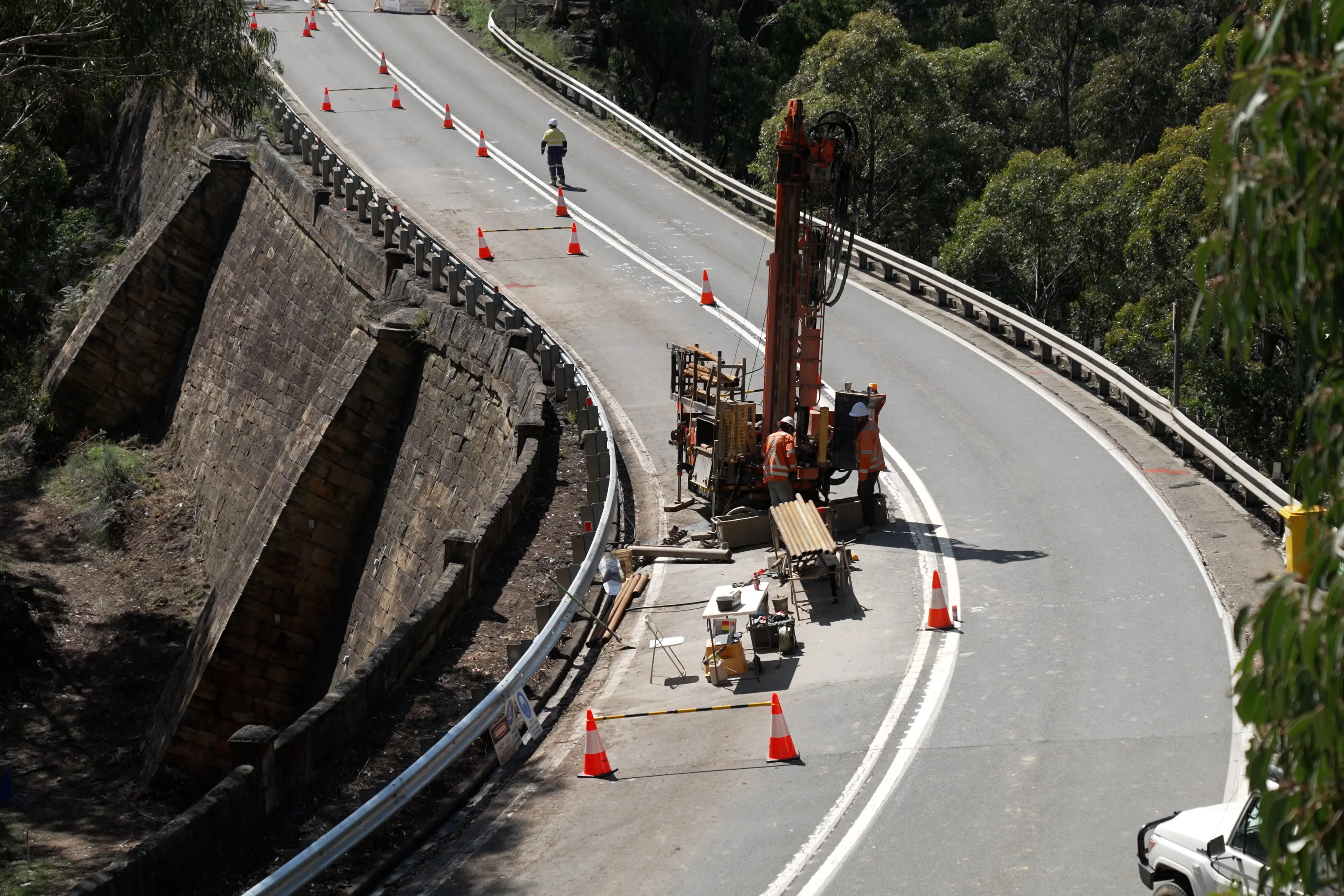
Since increased cracking was detected in early March, teams have carried out a program of investigations to understand what is happening at Mitchells Causeway.
“Since we detected the acceleration of cracking and increased movement in the causeway we have undertaken drilling, coring, investigative piling, seismic testing and the installation of extensive monitoring equipment within the road, retaining walls and underlying ground which have delivered a thorough understanding of current site conditions,” Mr Fuller said.
“We shared that the bedrock steps down lower under the westbound lane than the eastbound one, but importantly the lower bedrock layer is sound.
"This provides a foundation for a safe and suitable solution along the current alignment – which is the quickest way to restore this critical east-west link.”
Summary of key investigation findings at Mitchells Causeway:
The causeway fill is varied, mainly made of sand, with voids and boulders;
Lower bedrock is more sound than that at the base of the causeway;
Bedrock is two to four metres lower under the westbound lane than the eastbound lane;
Movement is mainly impacting the western wall;
Movement within the causeway has continued since it was closed to traffic and it remains unsafe for traffic.
Asphalt surface layers are around 250mm-300mm deep with thin and minimal base layers between it and the causeway fill.
Multiple full depth cracks rapidly appeared in the asphalt between Thursday 5 March when the eastbound lane was closed, and the full closure to both east and westbound traffic on the causeway overnight Sunday 8 March.
Mr Fuller said representatives were told all solutions must reinstate the highway with at least the same number of lanes and load capacity as it had prior to closure.
“Delivery timelines and how soon we can make this happen for the community are a key consideration," he said.
"We’ll be asking the experts to submit ideas, with initial options for valid or tangible solutions and confirmation of their capability to deliver on this by Friday 1 May so we can immediately start the shortlisting process.
“We plan to have contracts signed as soon as possible.
"We want to be pushing ahead with a solution in weeks, not months.
"We’re moving fast but not taking shortcuts.
"Teams were still picking up movement at the site on Monday and safety remains our top priority for the community, our people and our contractors.”
The select group of just over 20 companies invited to attend the briefing includes Australian and international companies with a track record of delivering major infrastructure projects.
Industry submissions will be due to Transport for NSW by Friday 1 May.