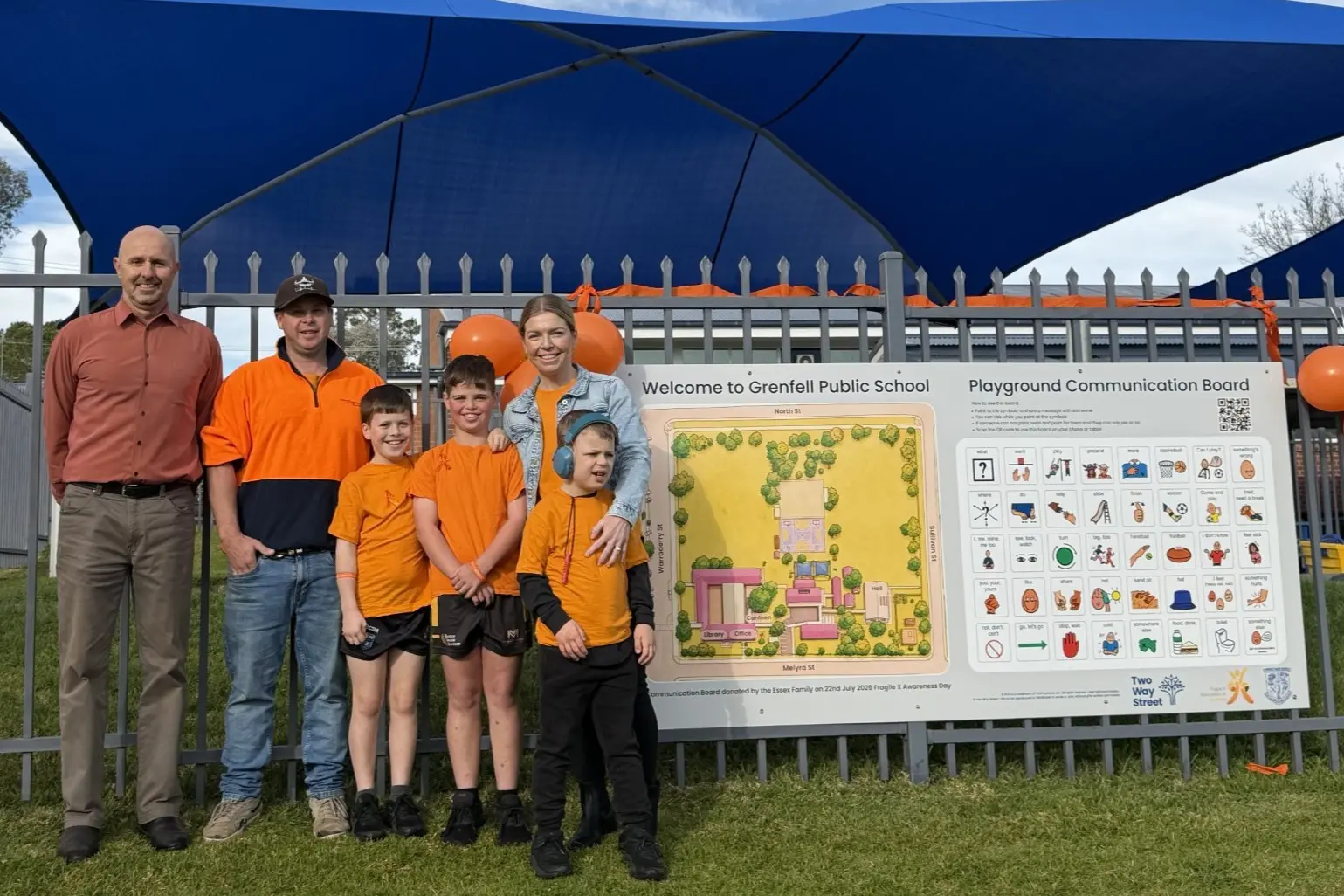
Students at Grenfell Public School now have access to a new communication board designed to support children of all abilities to communicate, connect and participate.

The board was officially unveiled on Fragile X awareness day, Tuesday 22 July, and was donated by Nev and Emily Essex as part of their commitment to promoting inclusion within the local community.

The project holds special significance for Nev and Emily, whose seven-year-old son, Billy, attends Grenfell Public School and lives with Fragile X syndrome and Autism Spectrum Disorder.

Billy experiences significant communication challenges and uses Augmentative and Alternative Communication (AAC) to help express his thoughts, needs and feelings.

"Communication is something many of us take for granted," Emily said.

"For children with complex communication needs, having access to visual supports like this can make a huge difference. It gives children another way to express themselves, make choices, build relationships and feel included."

The communication board was unveiled during a special school assembly attended by staff and students from Grenfell Public School.

Billy's older brothers, Max and Eddie, proudly unveiled the board, making the occasion especially meaningful for the Essex family and reinforcing the importance of creating an inclusive school community where every student has the opportunity to communicate.

To mark Fragile X awareness day, Grenfell Public School also held a mufti day, with students and staff encouraged to wear a touch of orange, the colour used across Australia to raise awareness of Fragile X syndrome.

The day provided an opportunity to celebrate inclusion, learn more about different communication needs and recognise that every child deserves to have their voice heard.

Emily said the project was also about raising awareness of Fragile X syndrome, the most common inherited cause of intellectual disability and the leading known single-gene cause of autism.

"Despite being the leading genetic cause of autism, Fragile X syndrome remains relatively unknown and widely misunderstood. As an inherited genetic condition, the Fragile X gene change can be passed through generations before anyone in a family receives a diagnosis.

"By recognising Fragile X awareness day and installing this communication board, we hope to raise awareness of Fragile X syndrome, increase understanding of the families it affects and highlight the importance of accessible communication so that everyone has the opportunity to be heard and included."

Nev and Emily would like to sincerely thank Grenfell Public School, particularly Principal Brent Cartwright, for embracing the project from the outset and recognising the value of creating a more inclusive environment for all students.

The school's support of both the communication board and Fragile X awareness day reflects a genuine commitment to ensuring every child has opportunities to communicate, connect and participate.

Emily said she hopes the communication board will become a valued resource for students for many years to come.

"Every child deserves to be heard, understood and included. This board is a simple but powerful reminder that communication looks different for everyone, and that's something worth celebrating," Emily added.

WHAT IS FRAGILE X SYNDROME

From Fragile X Association of Australia

In Australia it is estimated that each week one child is born with Fragile X syndrome and 20 children are born who are carriers of the FMR1 gene premutation.

Fragile X syndrome is one of a family of conditions caused by a mutation (change) to the FMR1 gene on the X chromosome.

The FMR1 gene is responsible for producing a protein important for brain development.

When the gene lengthens through the mutation, it switches off production of that protein involved in brain development and other functions.

Fragile X syndrome can cause a wide range of difficulties with learning, as well as social, language, attentional, emotional, behavioural and medical problems.

The effects of Fragile X syndrome on an individual vary and can range from mild to severe.

Men and boys commonly appear more severely affected by Fragile X syndrome, but women and girls may also be severely affected.

It is estimated that about 90,000 people in Australia are impacted by Fragile X in some way – as carriers of Fragile X, or with Fragile X syndrome.

Fragile X syndrome is the leading cause of inherited intellectual disability, affecting about one in 4000 males and about one in 6000 females.

Both males and females can be carriers of the Fragile X (FMR1) gene alteration and are called premutation carriers.

About one in 250 women and one in 800 men are Fragile X premutation carriers.

Conditions associated with being Fragile X Premutation carriers include:

  • Fragile X-associated Tremor Ataxia syndrome (FXTAS): A neurological condition with symptoms including shaking (intention tremor), unsteadiness (ataxia) and memory problems. FXTAS is often misdiagnosed as Parkinson’s disease.

  • Fragile X-associated Primary Ovarian Insufficiency (FXPOI): Which can lead to fertility problems and early menopause.

  • Fragile X-associated Neuropsychiatric Disorders (FXAND): A term to describe a range of physical and psychological issues some carriers may experience.

While there is as yet no cure for Fragile X syndrome, there are a range of treatment interventions and management strategies that are of great benefit.

To learn more about Fragile X Syndrome head to www.fragilex.org.au