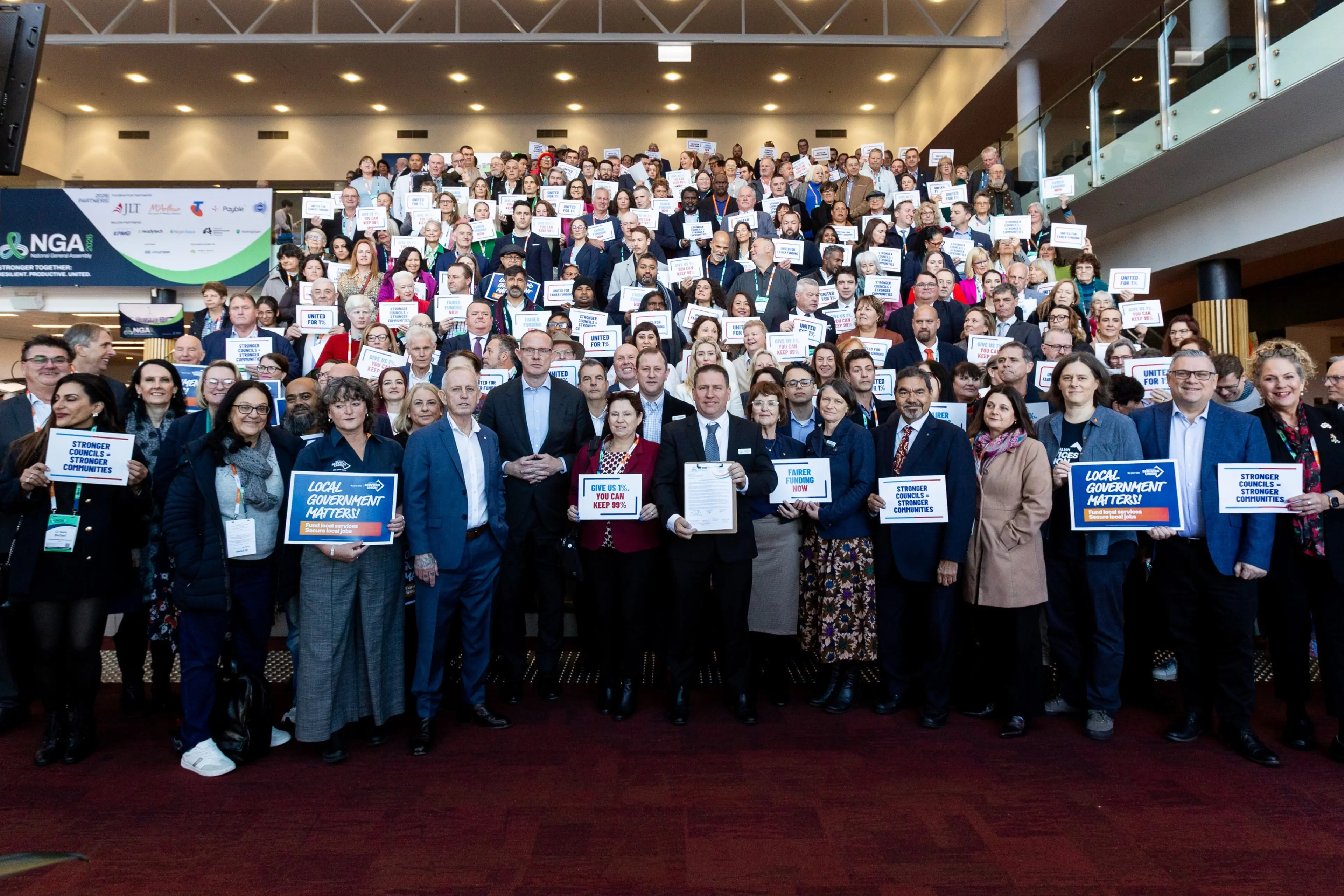
Councils from every state and territory have joined forces with unions representing the local government sector to warn Federal Parliament of a looming financial crisis.

A letter, signed by associations representing more than 500 councils nationwide, was endorsed at the National General Assembly of Local Government.

The letter will be sent to the Speaker of the Parliament as well as every MP and Senator in a move President of Local Government NSW Mayor Darcy Byrne said was unprecedented.

"Today mayors from every corner of the continent are joining with unions representing the whole Local Government workforce to say this crisis in funding for councils must be addressed," Cr Byrne said.

"In many regional communities in particular there is simply not enough funding for basic services to be maintained. That's why we have taken this unprecedented step to force the Parliament to act on this crisis."

This joint call to increase Commonwealth Financial Assistance Grants comes as a growing number of regional councils in particular face severe financial pressures that threaten basic services.

"Councils provide vital services and infrastructure that our national economy and productivity rely upon," the letter says.

"The success of our Australian system of government depends upon our councils succeeding at grassroots level.

"But this system is in jeopardy.

"Long term planning and delivery requires long term financial security and certainty.

"Councils have limited options to raise revenue and in many cases are highly reliant on untied financial assistance grants from the Commonwealth."

Weddin Shire Council has also highlighted the growing financial strain facing rural councils.

During discussions on the draft 2026-27 budget in May, Mayor Cr Paul Best said the council's financial position reflected the challenges faced across regional Australia.

"We rely very heavily on grants," Cr Best said.

He noted the council receives just $5.3 million a year from rates and charges despite managing a budget of around $30 million.

While approximately $8.3 million in road works has been funded through grants for the coming financial year, councillors acknowledged that external funding is becoming increasingly uncertain.

General manager Matthew Sykes said the decline in Commonwealth Financial Assistance Grants had become a significant concern.

"Australian Local Government Association recommended that it was one per cent of Commonwealth taxation revenue back in 1996," Mr Sykes said.

"It has not been at that level since that point. So now 30 years later, and in fact in the recent federal budget delivered it's dropped from 0.51 per cent to 0.49 per cent."

When adopting the council's 2026-27 budget in June, Cr Best said the issue was being felt by councils across the country following the Australian Local Government Association conference.

"Hopefully the state government and federal government listen a little bit more about we're not the only council," he said.

Federal Assistance Grants have fallen from one per cent of Commonwealth taxation revenue to barely half that over 30 years, United Services Union general secretary Graeme Kelly said.

"That decline has real consequences for the workers and communities who depend on council services," Mr Kelly said.

"Restoring the one per cent benchmark is the single most important thing Canberra can do for local government."

In NSW there are more than 50,000 council workers and National Secretary of the Australian Services Union, Emeline Gaske, highlighted the impact the crisis will have on the workforce.

“Council workers keep Australian communities running every single day,” Ms Gaske said.

“They collect our bins, run our libraries, maintain our roads and support communities through floods and fires.

"They do this work professionally and with commitment, but they need councils that are properly resourced to back them up.”