
PHOTO
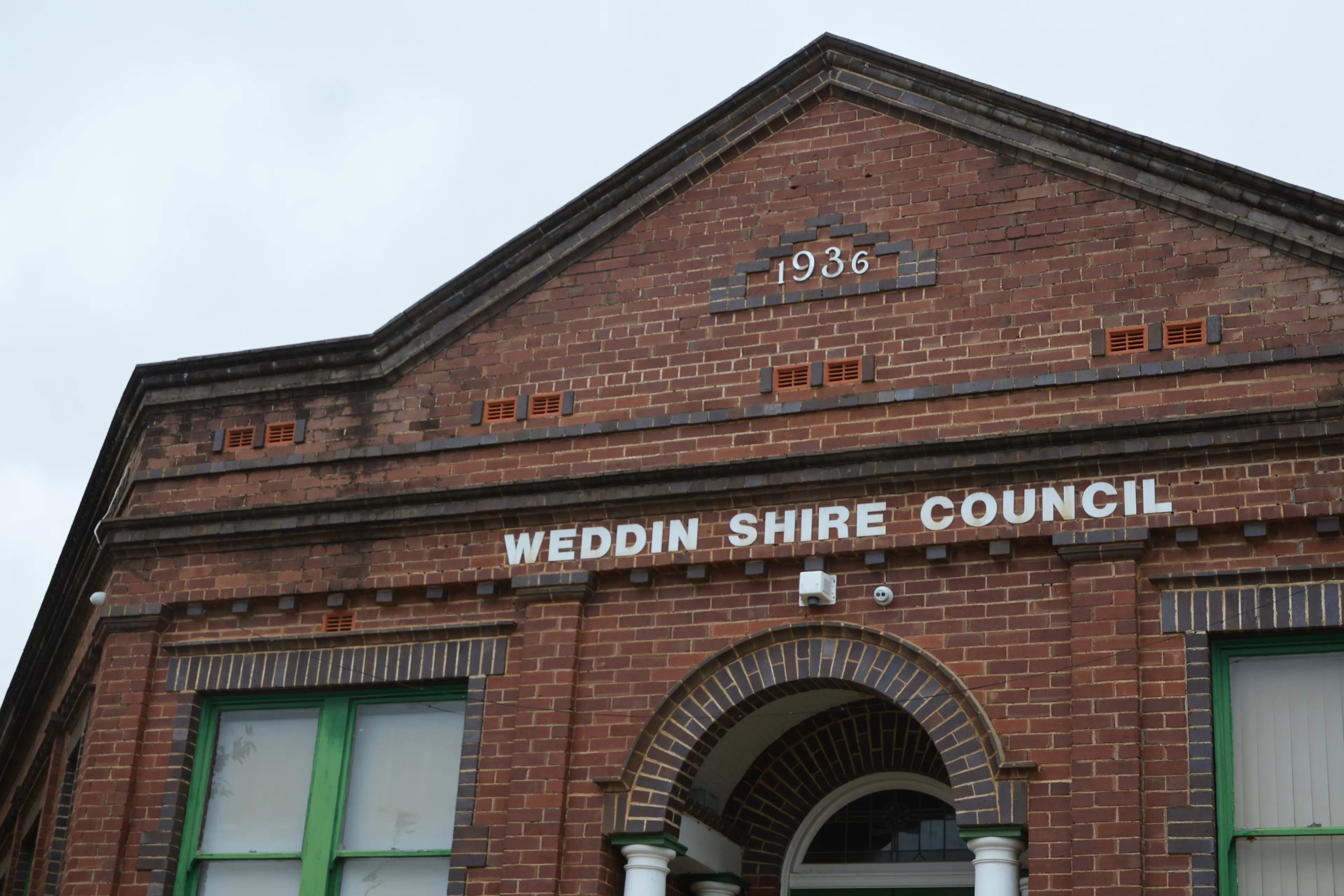
Weddin Shire Council has acknowledged significant financial pressures as it prepares to seek community feedback on its draft 2026-27 Operational Plan.
At May's Ordinary Council Meeting councillors moved into a Committee of the Whole to discuss the draft budget which forecasts $20.318 million in income against $30.419 million in expenses, leaving a net operating deficit of $10.101 million.
Even after excluding depreciation of $7.85 million the budget still shows a deficit of $2.251 million.
The draft plan reflects a 4.2 per cent rate increase set by the NSW Independent Pricing and Regulatory Tribunal (IPART) and at the same time costs continue to rise across services.
Sewer charges will increase by 10 per cent as the underground infrastructure supplying the new sewage treatment plant built in 2022 is aged and requires significant investment.
There are also increases in user fees with certain construction certificate fees, such as for fences, have more than doubled.
Some statutory fees remain unknown and will be set later by authorities.
But some costs have also been reduced.
As a result of the Grenfell Library transitioning to the regional Central West Libraries model, services such as interlibrary loans and reservations are becoming free.
Councillors raised concerns about the budget given council's financial reliance on external funding.
Councillor Chad White questioned whether a special rate variation was needed.
"We're promising the community that we're going to do this and that, how are we going to achieve it?" Cr White asked.
Mayor Paul Best said the size of the deficit was his biggest concern.
"That $10.1 million deficit is a really big figure," he said.
While a large portion of the deficit relates to non-cash depreciation he warned that it still reflects a deeper issue.
"We're not putting that money aside to replace our assets in the future and that's a major concern."
The Mayor discussed the scale of council's financial challenge with just $5.3 million in annual income from rates and charges compared to a total budget of around $30 million.
"We rely very heavily on grants," Cr Best said.
While around $8.3 million in road works is already funded through grants for the coming year councillors acknowledged that grant funding is becoming less certain.
General manager Matthew Skyes reinforced this concern noting that the federal Financial Assistance Grant, which is a key funding source, has declined significantly over time.
"Australian Local Government Association recommended that it was one per cent of Commonwealth taxation revenue back in 1996," Mr Skyes said.
"It has not been at that level since that point. So now 30 years later, and in fact in the recent federal budget delivered it's dropped from 0.51 per cent to 0.49 per cent."
Even when looking at the smaller deficit of around $2 million, councillors recognised the challenge of closing the gap.
Mr Skyes confirmed that this shortfall would be funded from council's restricted cash reserves.
"That will really put us balancing a fine line," he said.
Mayor Best outlined the dilemma facing council when considering cost-cutting measures listing major expenses such as, $390,000 for the emergency service levy, $583,000 to operate swimming pools, $498,000 for parks and gardens and $686,000 for insurance.
"To reduce insurance you have to reduce what you insure, meaning you'd have to sell assets," Cr Best said.
"It's $158,000 a year just to maintain toilet blocks, do we close toilet blocks and not maintain them to save money? These are the sort of questions we are facing."
Councillor Wezley Makin warned against cutting services too deeply arguing it could harm the long term viability of the community.
"It would be quite easy to remove a lot of things, but at the detriment of our community," Cr Makin said.
"If we close the pool, there goes the swimming club, there goes the community, the population moves away. There's not going to be a new doctor come to town because there's nothing to look forward to.
"If we start cutting corners to save a few dollars its going to come at a higher cost in 10 years time."
He described the situation as "a double-edged sword", balancing immediate savings against long-term impacts.
Several councillors agreed that the long term solution lies in finding new revenue streams.
Councillor Simon Rolls suggested council should explore ways to generate ongoing income from new developments pointing out large projects that come to town currently contribute little beyond their initial development application fees.
Mr Skyes said council would review potential revenue sources in the coming year, including developer contributions that are charged by most other councils but not currently applied locally.
The General Manager identified areas where council could possibly save money but councillors agreed to retain funding for all.
This included the development of a housing strategy, a new governance officer role, a sewer development and servicing plan, a business improvement fund (reduced to $80,000 from $250,000), a biosecurity service review, pigeon eradication and property maintenance.
Councillors agreed cutting these could impact growth opportunities, particularly the ability to attract funding.
The Draft Operational Plan 2026/2027 including the Draft 2026/2027 Schedule of Fees and Charges (Appendix A), and Draft 2026/2027 Budget and the Draft Long Term Financial Plan 2026/2027- 2035/2036 are available under public exhibitions on the council website – https://www.weddin.nsw.gov.au/Council/Public-Exhibition – or at the council’s administration building at 73 Camp Street or the Community Hub Building at 88 Main Street.
Submissions close at 5pm on Monday 22 June.
Submissions can be provided to Council by email to mailto:mail@weddin.nsw.gov.au or in writing to Weddin Shire Council, 73 Camp Street Grenfell NSW 2810.